On June 27-28, the 13th International Workshop on Regional, Urban,and Spatial Economics in China (RUSE) was held at the Xueyuan South Road campus of the Central University of Finance and Economics(CUFE) in Beijing. The event brought together a raft of dignitaries including CUFE Vice President Chen Binkai, Stanford University Chair Professor Li Shanjun, Massachusetts Institute of Technology(MIT)Chair Professor Zheng Siqi, Vice Dean of Fudan University's School of Economics Chen Zhao and National University of Singapore Chair Professor Qin Yu. Others included Professor Hans Koster from Vrije Universiteit Amsterdam(VU Amsterdam), along with He Yang, president of CUFE's Academic Journal Society, Guo Dongmei, dean of CUFE's School of Economics, and academic peers and young scholars from dozens of domestic and overseas institutions of higher learning. The opening ceremony and keynote speeches were hosted by Guo Dongmei.
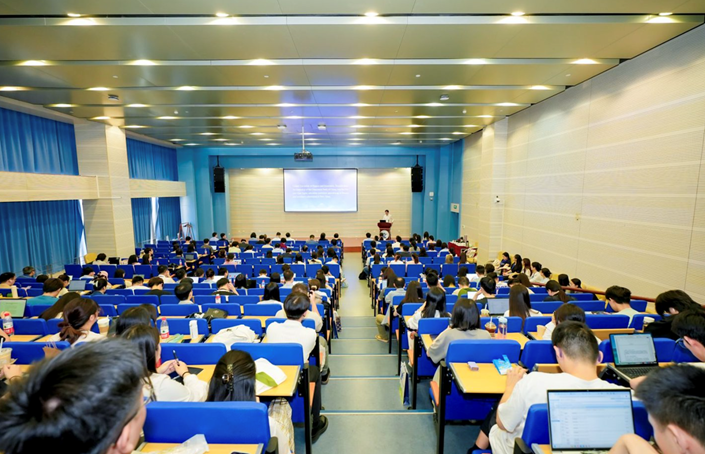
In his speech, Chen Binkai emphasized that coordinated regional development was a crucial support for promoting high-quality development — and was an important prerequisite for leveraging China's large-scale market advantages and achieving the goal of common prosperity. He expressed his hope that the symposium would further encourage in-depth discussions among scholars from home and abroad on major practical issues related to China's regional development— providing more outstanding academic contributions to theoretical innovation and policy practice in regional economics.
During the keynote speeches, Li Shanjun noted that the spatial clustering of China's new energy vehicle industry chain was a key factor in the rapid rise of the industry. Zheng Siqi pointed out that the presence of multinational corporations could enhance urban quality of life through channels such as talent inflows, supply chain tracking and expanding consumer demand. Chen Zhao highlighted the fact that factors related to the household registration system — such as child-rearing costs and marriage matching barriers — jointly influenced the marriage and fertility choices of the floating population. Promoting the equalization of public services could help improve the welfare of the floating population. Qin Yu presented cutting-edge research on the impact of low-carbon hotel certification, revealing the importance of information disclosures and dissemination for the green transformation. Research from Hans Koster found that the interaction between declining housing quality and changes in residential structures reinforced the long-term persistence of urban decline.
On the afternoon of June 28, parallel sessions were held at the Academic Hall of CUFE. Scholars engaged in discussions on topics such as the labor market, enterprises and trade, land and housing, and transportation and infrastructure.
The symposium was hosted by the School of Economics of CUFE,and was co-organized by the Journal of Regional Science, theChina Economic Review, the Journal of Central University of Finance & Economics, and the Research Institute of the Chinese National Community at CUFE. The event facilitated exchanges and mutual learning among scholars in the fields of regional, urban,and spatial economics from both domestic and overseas institutions — providing strong support for the development of related disciplines and the practice of coordinated regional development in China.
Writers: YANG Qinglong
Reviewers: GUO Dongmei, WU Nan
Editors: WANG Xinyu
Approvers: HUO Xiaoran


 NEWS
NEWS