The Digital Economy and Urban Development Forum, part of the 2026 Global Digital Economy Conference, was held at the China National Convention Center in Beijing on July 3. Ma Haitao, president of the Central University of Finance and Economics (CUFE), attended and delivered a speech. The forum was held by the Beijing Academy of Social Sciences, and co-organized by CUFE, the Beijing Future Science City Administrative Committee and Beijing Zhongcaiyuan Technological Development Co Ltd. Over 100 representatives from government departments, institutions of higher learning, research institutes, enterprises, and the media participated.
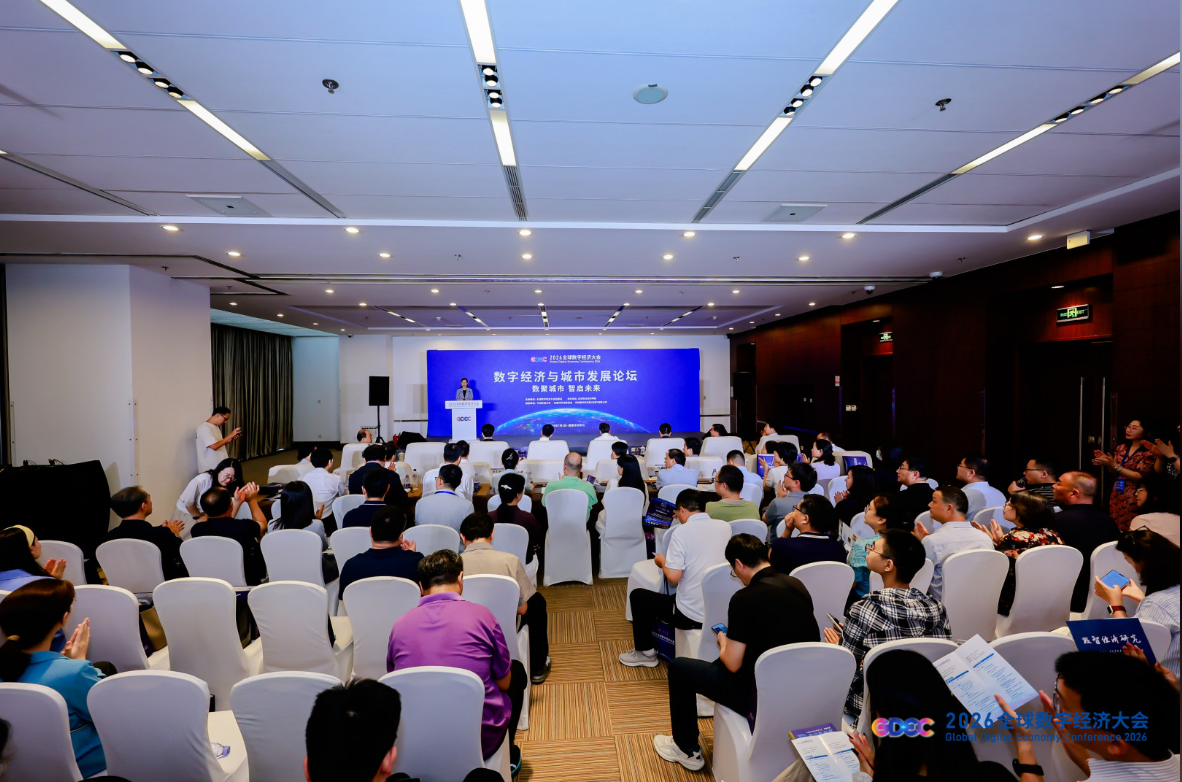
In his address, Ma Haitao noted that CUFE, building on its strengths in finance and economics, was seizing the opportunities presented by the digital economy. Moreover, it was actively conducting research in frontier areas such as urban digital governance, data factor circulation and low-altitude economy governance — and had consistently produced distinctive research outcomes. He called for deeper collaboration among government, industry, academia, research and applications. That was to jointly build a research community on the digital economy — providing theoretical support and practical models for high-quality urban digital development.
During the results release session, Party Secretary of CUFE's School of Government Yu Peng, and Associate Professor Wang Wei jointly unveiled the White Paper on Low-Altitude + Urban Governance 2026: Toward a New Paradigm of Spatiotemporal Governance. The document proposes a transition of urban governance from two-dimensional to three-dimensional spatiotemporal frameworks, and summarizes four models for low altitude + urban governance across China. Moreover, it offers policy recommendations covering the development of low-altitude intelligent-connected infrastructure, tiered airspace management and one-network integrated flight management, data security enhancement, key technology breakthroughs and ecosystem building.
In the keynote speech session, CUFE Vice President Li Zheng delivered a presentation entitled The Art of Smart City Governance: The Integration of AI and the Rule of Law. In it, he pointed out that urban governance was shifting from text-based approaches to digital-based ones. He advocated using Bayesian Decision Theory. This was in order to build anthropomorphic decision frameworks and to promote the deep integration of human carbon-based intelligence with AI silicon-based intelligence — forming a hybrid rational governance system with complementary strengths.
The forum showcased CUFE's research strengths in interdisciplinary fields such as digital finance, low-altitude governance, and the smart rule of law — and further expanded its channels for government-industry-academia-research collaborations. Moving forwards, plans are for CUFE to continue to leverage its think-tank advantages at the intersection of the digital economy and urban governance. It will also deepen multi-party collaborative innovation, and contribute "CUFE wisdom" toward building more inclusive, trustworthy and sustainable global digital-friendly cities.
Writers: WANG Xiaotong
Reviewers: NING Xiaolin
Editors: WANG Xinyu
Approvers: HUO Xiaoran


 NEWS
NEWS