The Fourth International Conference on Actuarial Science, Quantitative Finance and Risk Management was held at the Xueyuan South Road campus of the Central University of Finance and Economics (CUFE) in Beijing from July 4 to 6. Over 240 experts, scholars, and faculty and student representatives from more than 10 countries and regions participated — discussing cutting-edge topics in actuarial science, quantitative finance and risk management. The opening ceremony featured speeches from CUFE Vice President Cai Yanyan, Secretary-General of the China Association of Actuaries Zhang Xiaolei, and General Manager of Old Mutual-CHN Energy Life Insurance Company Limited Cai Lianhe. Zhou Hua, dean of CUFE's School of Insurance and China Institute for Actuarial Science, presided over the ceremony.
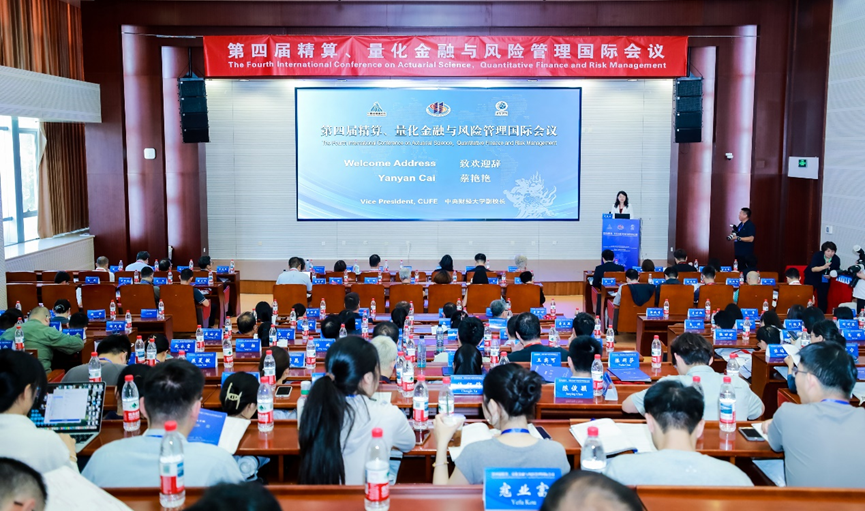
The Fourth International Conference on Actuarial Science, Quantitative Finance and Risk Management took place at CUFE from July 4 to 6.
Cai Yanyan highlighted the conference as a premier international academic exchange platform focusing on global challenges in risk, fintech and insurance, covering multiple disciplines such as actuarial science, mathematics, finance, and risk management, with significant academic value and practical relevance. She emphasized that CUFE will take this conference as an opportunity to further deepen industry-academia-research collaboration, promote interdisciplinary studies and talent cultivation, serve national strategies with solid research, and contribute more wisdom and strength to the improvement of the global risk governance system.
For his part, Old Mutual-CHN Energy's Cai Lianhe shared insights from his journey "from actuarial science to management". He suggested that actuarial education should strengthen skills in communications, business judgment and interdisciplinary perspectives — advocating deepening university-industry collaborations to cultivate future business leaders and industry pioneers.
During the conference report session, Professor Hong Yongmiao from the University of Chinese Academy of Sciences proposed a model averaging method based on dynamic time-frequency decomposition. This method is said to overcome the limitations of traditional models that ignore frequency heterogeneity. That's constructing weighted candidate models and optimizing combination weights by dynamically decomposing predictors at each prediction point. Meanwhile, Professor Chen An from Ulm University in Germany pointed out that the ambiguity of risk attitudes did not simply increase demand for insurance, but altered future assessments by distorting the valuation weights of adverse states. Insurance, essentially a tool for cross-state wealth transfer, saw the effect of ambiguity depending on the direction of the transfer. This mechanism explained the reasons for the demand differences between life insurance and long-term care insurance. Professor Leonie Tickle from Macquarie University in Australia stated that the actuarial industry was undergoing profound change due to increasing technological innovations, evolving risk landscapes and rising expectations from various stakeholders. She emphasized the need to actively break traditional disciplinary boundaries, deepen collaborations with industry and professional institutions — and to promote the integration of education, research and practice to cultivate future talent with both technical depth and adaptive judgments. The session was chaired respectively by Zheng Sujin, vice dean of CUFE's School of Insurance and China Institute for Actuarial Science, Professor Shi Peng from University of Wisconsin–Madison and Professor Jin Zhuo from Macquarie University.
In the special report session,Professor Edward (Jed) Frees from University of Wisconsin–Madison addressed climate risks such as hail, hurricanes and floods — highlighting that spatial dependence could weaken the diversification function of risk pools. Professor Phillip Yam from the Chinese University of Hong Kong tackled the issue of numerous categorical covariates and time-varying potential clusters in cyber risk data. He proposed a superposed marked Hawkes process — combined with classifiers such as CIBer, CART, and MLP — to estimate dynamic clustering and model parameters. The session was chaired respectively by Professor Chen Hua from the University of Hawaii at Manoa and Professor Liu Jingzhen from CUFE's School of Insurance and China Institute for Actuarial Science.
The conference featured 70 parallel academic sessions covering topics such as cyber risks, quantitative finance, pensions and health risks, catastrophe insurance and reinsurance, risk measurements and stochastic control, sustainable investment, and decision making under ambiguity. Scholars shared their latest research and engaged in in-depth discussions.
Overall, the conference underscored CUFE's academic expertise and international dialogue capabilities in actuarial science and risk management — injecting new vitality into global academic cooperation and supporting financial security and the modernization of national governance.
Writers:LI Honggeng, LYU Sicong, LI Fan
Reviewers:LYU Li, ZHOU Hua, ZHENG Sujin
Editors: WANG Xinyu
Approvers: HUO Xiaoran


 NEWS
NEWS