The 30th Annual Conference of the Asia-Pacific Risk and Insurance Association (APRIA) — with its theme of "Insurance in an Interconnected Risk World: Collaboration, Prevention, and Shared Prosperity" — was held on July 26-29 at the Xueyuan South Road campus of the Central University of Finance and Economics, also known as CUFE, in Beijing. The conference featured one keynote speech, nine invited presentations and 29 parallel sessions, with nearly 200 faculty and student representatives from dozens of countries and regions attending.
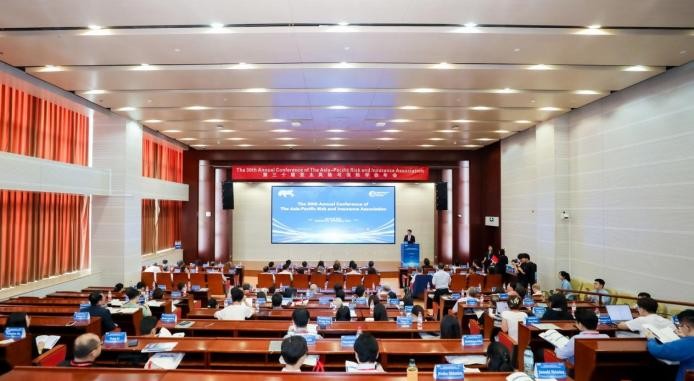
Proceedings get underway at the conference venue
On the morning of July 27, the conference opened in Academic Hall 202. CUFE Vice President Cai Yanyan and APRIA President Katja Hanewald from the University of New South Wales attended and delivered speeches, while Zhao Yulong, president of the Insurance Association of China (IAC), gave the keynote address.
Cai Yanyan reviewed CUFE's history and its deep roots in insurance and actuarial education, noting that the value of insurance collaboration becomes increasingly evident in the context of interconnected risks. She called for deepening international cooperation in insurance across the Asia-Pacific region, leveraging academic research and international exchanges to strengthen people's wellbeing and to promote high-quality industry development.
Katja Hanewald looked back on APRIA's 30-year journey, calling on the industry to move beyond a single-claim payout mindset and to place greater emphasis on proactive risk prevention and multi-party collaboration. She encouraged academics to strengthen their cross-border academic cooperation, and then officially declared the conference open.
Zhao Yulong systematically reviewed the current state, development experience, and prospects of China's insurance market. He noted that China's insurance sector ranked among the world's largest in scale — with a continuously optimizing structure and notable achievements in areas such as green insurance, inclusive insurance, pension insurance and digital insurance.Relying on top-level planning, opening up and digital transformation, the industry was shifting towards high-quality development. Facing multiple changes such as aging demographics and climate risks, Zhao said market opportunities remained exciting. The industry must uphold risk control fundamentals, deepen reforms and its opening-up, and to contribute to high-quality economic development.
The invited presentation session featured a rich lineup of leading speakers. Xing Jing, CEO of Renascence Insurtech, shared an AI solution integrating real-world medical data. It leverages large models to optimize intelligent underwriting, pricing for pre-existing conditions, health interventions and claims processes — creating a new ecosystem for health insurance. Feng Han, executive director of Jingyou Technology and CEO of Loginsight Limited, demonstrated the application of AI agents in auto insurance claims — showcasing the broad prospects of data, AI and IoT technologies in driving the efficiency revolution in the auto insurance industry.
Gene Lai from the University of North Carolina at Charlotte (UNC Charlotte) pointed out that AI can precisely identify risks and reduce operating costs, but firms need to implement compliance and explainability mechanisms. He emphasized that digital transformation must balance technological innovation with risk control and uphold the core principles of insurance operations. Andrei Badescu from the University of Toronto proposed a driving risk assessment method based on continuous-time Hidden Markov Models — using telematics time-series data to construct anomaly indices that effectively predict claims probabilities — supporting differentiated auto insurance pricing. Li Xiaoxuan, general manager of the Risk Research Institute of PICC Property and Casualty, analyzed the impact of climate risk on China's property insurance — using catastrophe modeling, combined with multiple global climate models to demonstrate risk trends in meteorological disasters. Jing Ai from the University of Hawaii at Manoa studied the relationship between informal protection and commercial insurance using mutual-aid platform data — finding that clear claims information retains users and that low-cost mutual aid can serve as an entry point for guiding the public to purchase commercial insurance.
Giacomo Pasini from Ca' Foscari University of Venice compared long-term care policies across countries. He found inconsistencies in assessment standards and implementation scales, with about 30 percent of elderly people in the EU relying on non-relative caregivers — making such informal care an important supplement to formal elderly care systems.
Shiko Maruyama from the University of Osaka analyzed regional differences in healthcare expenditure using evidence from China and Japan, pointing out administrative-market mismatches and differing drivers of expenditure variations in the two countries. Wang Jian from Wuhan University reviewed the current state and diverse product models of China's "Huiminbao" ("insurance benefiting the people") — noting such issues as adverse selection and insufficient coverage for rare diseases, and highlighting the fact that China's commercial health insurance still has room for improvement.
From July 28-29, 29 parallel sessions in all featured 84 academic presentations. Participants — among other frontier areas — exchanged the latest research findings on climate risk and insurance, health insurance, agricultural insurance, ESG and sustainable development, longevity risks, cyber insurance, AI and insurance technology, as well as the latest in insurance regulations.
During the event, the Executive Committee Meeting, Board Meeting, General Assembly, and President's Luncheon were also held, and outstanding papers were recognized. CUFE graduate students Zhao Ying and Qi Mengjia received the Yu Ziyou Memorial Scholarship and South Korea's Kyobo Life Insurance Scholarship.
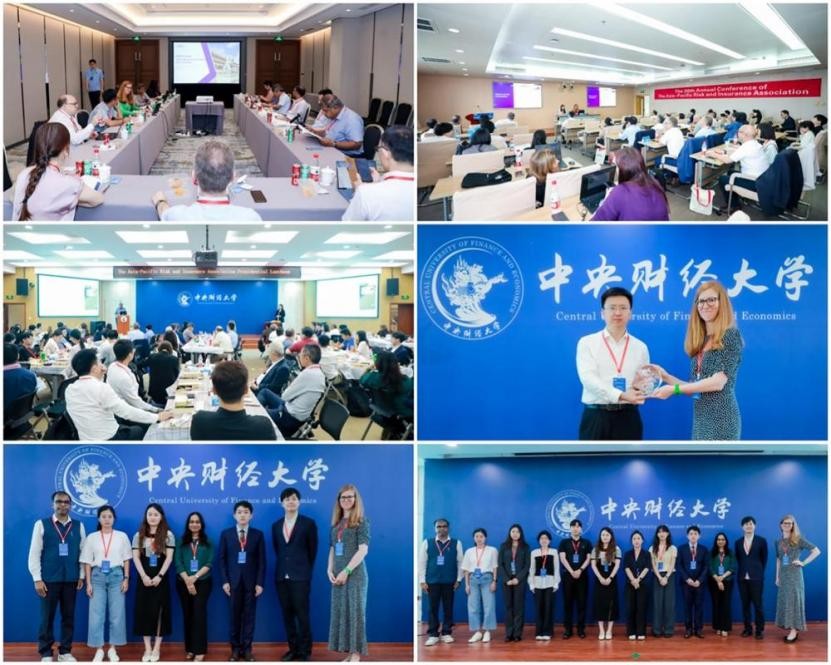
A series of scenes from the event
The conference provided a high-level academic dialogue platform for risk and insurance in the Asia-Pacific region — facilitating the integration of cutting-edge ideas, deepening cross-border research collaboration, and further enhancing CUFE's international academic influence. The event was hosted by APRIA, organized by CUFE's School of Insurance and China Institute for Actuarial Science. Taikang Life Insurance Co Ltd was the lead partner, with partners AIA Life Insurance Co Ltd, ERGO (China) Enterprise Management Co Ltd, Datong Insurance Sales and Service Co Ltd, and Beijing Huaxia Yicheng Information Technology Co Ltd.
Writers: JING Jiajie, WANG Wei
Reviewers: ZHOU Hua, LYU Li, MA Bing
Editors: WANG Xinyu
Approvers: HUO Xiaoran


 NEWS
NEWS