An academic paper titled "CEO tax effects on corporate misconduct: Evidence from CEOs' capital gains taxes", co-authored by Assistant Professor Ke Junqiang of the School of Accountancy of the Central University of Finance and Economics (CUFE), Professor Ge Rui of Shenzhen University, Professor Ma Zhiming of Peking University, and Professor Ruan Lufei of San Francisco State University, has been published in Volume 31, Issue 2 (June 2026 edition) of theReview of Accounting Studies(RAST). RAST is one of the top five international journals in the field of accounting. You can access the paper by clicking:https://link.springer.com/article/10.1007/s11142-026-09945-4.
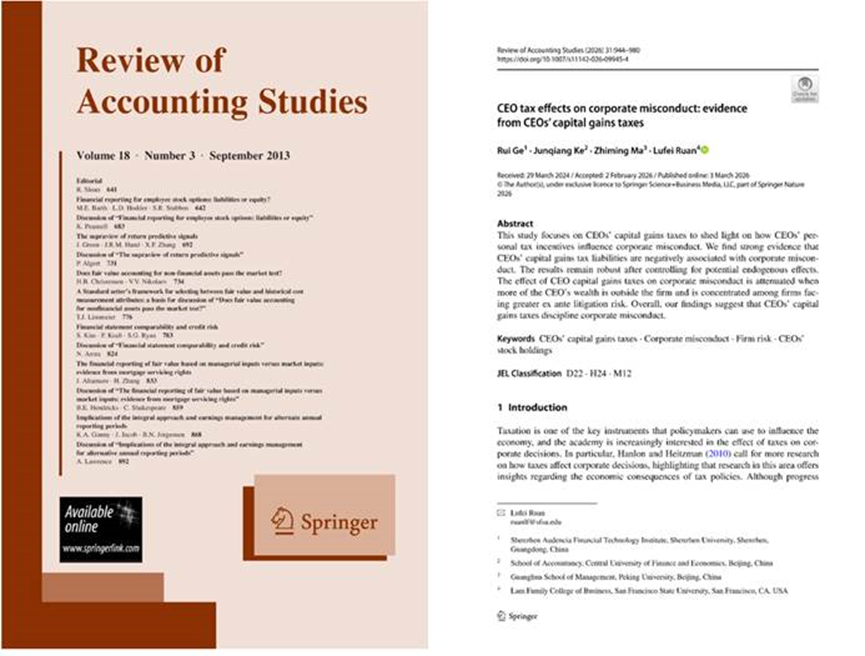
The study shows that CEOs' capital gains taxes have a significant deterrent effect on corporate misconduct. Specifically, the higher the capital gains tax burden on CEOs, the lower the penalty fees and the fewer the instances of corporate misconduct. The analysis shows that this negative effect is weakened when a CEO's wealth is more heavily invested outside the company, but becomes more prominent when the company faces higher litigation risks. This suggests that capital gains taxes create a "lock-in effect", causing CEOs to hold more company stock, thereby exposing them to company-specific risks and compelling them to avoid misconduct that could increase these risks. Further analysis indicates that CEOs' capital gains taxes significantly constrain different types of corporate misconduct, including those related to safety, the environment, and employment.
This paper fills a gap in existing literature on the relationship between executives' personal taxes and corporate misconduct, expanding research on the economic consequences of CEOs' capital gains taxes and the factors influencing corporate misconduct. It is a significant contribution to the body of literature on howexecutives' personal taxes affect corporations’ decision-making. The findings offer policy insights for relevant departments, helping them tooptimize capital gains tax systems and handle corporate misconduct, as well as practical guidance for companies to improve executive incentive and oversight mechanisms.
Writers: GAO Yihua
Reviewers:WU Xi,ZHENG Dengjin
Editors: WANG Xinyu
Approvers: HUO Xiaoran


 NEWS
NEWS